This week i explored another amazing tool, which is Twine. It is an open-source tool for telling interactive and non linear stories. I used it to create a story about the event which happened to me very recently. The story was when i ordered an e-text from Pearson for one of my course. I ordered 1 quantity and they charged me for 2 quantity, so instead of doing nothing, i contacted the customer support and told them my problem and i was able to get my refund.
I really enjoyed using Twine, it was really easy to use.
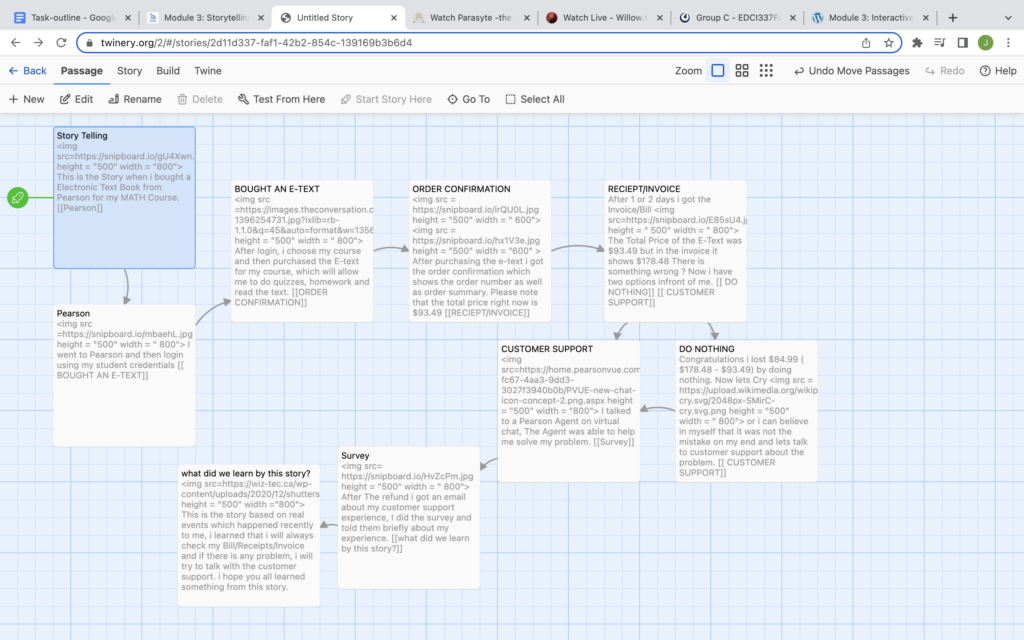
Please Click me to view my story
Reflection Questions
Q1) In the reading this week, 7 Storytelling Techniques Used by the Most Inspiring TED Presenters, which of the presenters did you find most compelling? What technique(s) did you recognize in their talk?
After watching all of the presenters, i found Richard Turere speech the most compelling because i was amazed how the 12 year old boy created the invention of “lion lights” to save cows as well as lions.
The StorytellingTechniques which i recognized in Richard Turere speech:
- Immerse your audience in the story: Richard Turere speech was very clear, i was able to understand every word he was saying, From the very start when he talked about Nairobi National Park i was immersed in his story. Moreover, his facial expression were making me feel to his story.
- Tell a personal story: His speech was on the invention he did to help save his cattle’s and prevent the killing of lions. All the photos and diagrams were real and represented his homeland. Therefore, it was clearly a personal story.
- Create suspense: His speech was full of suspense, the way he told us how he tackle the problem, first he used fire but that did not work so he used a scarecrow but that also did not work , so he has to try another method which resulted in his invention “lion lights”. Therefore, he created a suspense in his speech.
- Bring Characters to life: Every word he said and picture he showed created a mental image of the problem his family faced and how he solved that problem.
- Build up to S.T.A.R. moment: From describing the problem to showing us how to solve a problem and further motivating us that he still has to do more invention to help his people was really a S.T.A.R. moment.
- End with a positive Takeaway: At the end he told us his dream that he wants to become aircraft engineer and pilot. Further, he told that he wants to create his own electric fence. which for me is a positive takeaway.
Q2) What storytelling techniques have you used instinctively and which ones require more work for you? Which techniques will you focus on moving forward?
The Storytelling techniques which i used instinctively while creating my story were, tell a personal story– i shared my recent event as a story, create suspense– so i used real receipts in my story which will create a suspense according to my story, immersed your audience in the story– i used picture, emoji and text in my story to engage my audience with my story, end with a positive Takeaway– at the end i shared what we learn from this story, which is that if we do anything wrong while purchasing something then we should talk to customer support because it will help us solve a problem and you may find that you did not do anything wrong it was just a technical error.
I think end with a positive Takeaway required more work for me because i wanted to explain the purpose of my story very clearly to the audience.
I will focus on Show. Don’t tell technique because even though i showed all the photos in my story, I also described them. I did it because i wanted to tell my audience as much as possible about my story and thus i forgot about this technique.
References: copy images address from google( emoji, book, let’s chat and receipt in the hand ). Module 3 EDCI 337.


